Best Luxury Hotels in Paris: Where to Stay for a Special Trip
Paris has a way of raising your expectations for every hotel you'll ever stay in afterward. I made that mistake on my first trip — booked a decent boutique place in the Marais, thought I was being clever, and spent the week walking past the Plaza Athénée wondering what it felt like to actually stay there. The second trip, I fixed that. Three nights at Le Bristol. Came home a changed person. The point is: luxury hotels Paris offers aren't just accommodation. They're a full experience — breakfast at a Michelin-starred restaurant, a butler who knows your name by day two, a spa that makes Parisian wellness feel like a birthright.
France officially awards a "Palace" designation — managed by Atout France — that goes beyond five stars. Cultural significance, a high staff-to-guest ratio, exceptional dining, inspectors who actually show up. Paris has around twelve Palace hotels. Six are worth your serious attention: Le Bristol, the Ritz Paris, Hôtel Plaza Athénée, Shangri-La Paris, Hôtel de Crillon, and Park Hyatt Paris-Vendôme. This covers all six honestly — prices, what they're actually good for, and which makes sense depending on what you're after.
Le Bristol Paris: Old-School Elegance That Delivers
Le Bristol sits on Rue du Faubourg Saint-Honoré — thirty seconds from the highest-end shopping in Paris, fifteen minutes on foot from the Élysée Palace. The hotel dates to 1925. Rooms start around $1,590/night in shoulder season; peak summer and Fashion Week push that to $2,700–$3,000. Suites climb past $4,000. The rooftop pool on the sixth floor — heated, retractable roof — is one of the best hotel pools in any European capital. Full stop. Épicure, the three-Michelin-star restaurant helmed by Chef Eric Frechon, is worth booking even if you're not staying. The rooms are French classic — Louis XVI furniture, silk fabrics, nothing trying too hard. I asked the concierge on my second morning to fix a train booking I'd made through a third-party app; sorted in twenty minutes, zero condescension. That's the Bristol.
Ritz Paris: The Most Famous Address in the City
The Ritz Paris on Place Vendôme is the one people mean when they say "the Ritz." Coco Chanel lived here. Hemingway drank here — the bar still carries his name. The hotel closed for four years of renovations, reopened in 2016, and hasn't wavered since. Rooms start around $2,228/night; budget $2,700–$3,400 during busy periods. What the Ritz does best: service that feels personal without hovering. The Espadon restaurant has two Michelin stars. The Ritz Club in the basement is accessible to non-guests for cocktails — worth knowing. Place Vendôme is five minutes from the Tuileries, ten from the Louvre. If you're celebrating something specific, mention it when you book; the front office will arrange things you didn't know to request.
Hôtel Plaza Athénée: Avenue Montaigne and Alain Ducasse
Plaza Athénée is on Avenue Montaigne — the Dior flagship is twenty meters away. Louboutin, Chanel, Valentino all within two blocks. Rooms start around $1,635/night, averaging $2,470 for a standard double. The hotel's signature red geraniums drape every balcony; you've seen the photos, and they're somehow more impressive in person. The main draw beyond location is Alain Ducasse au Plaza Athénée — three Michelin stars, focused on "naturalité" (fish, vegetables, cereals, almost no meat), executed at a level that permanently adjusts your benchmark for good food. Book the restaurant months ahead, separately from your room reservation. The Dior Institut spa inside the hotel does treatments developed exclusively with the brand — worth half a day even if you're not a hotel guest.
Shangri-La Paris: Eiffel Tower Views, Properly Done
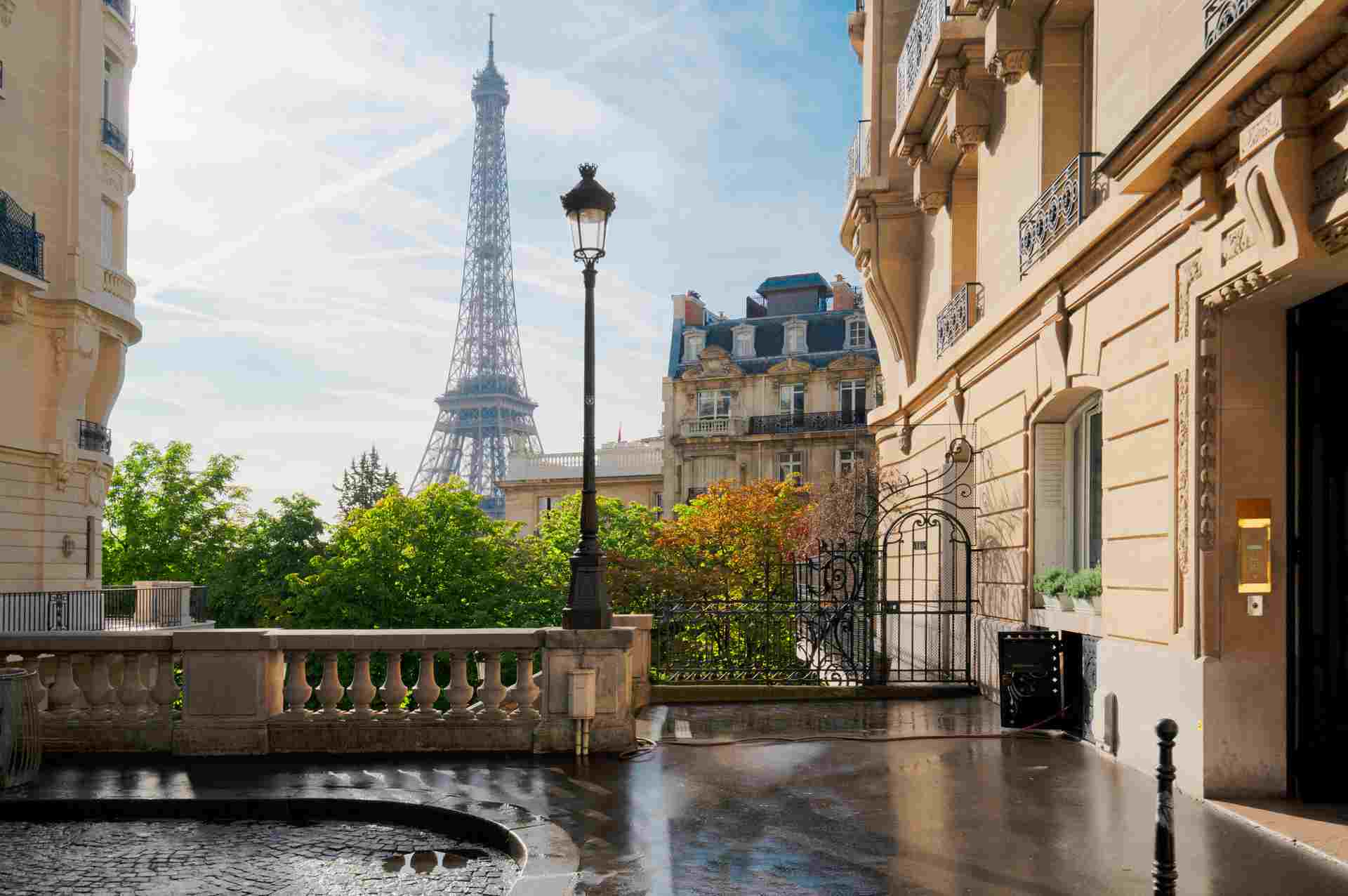
The Shangri-La used to be Napoleon Bonaparte's great-nephew's private mansion. That context matters when you walk in. Entry rooms start around $1,680/night. What separates it from the others: Eiffel Tower views from several rooms and suites — real, direct views across the Seine, close enough to watch the nightly light show from bed at 11 PM. The La Bauhinia afternoon tea is €95/person. Shang Palace (one Michelin star) does Chinese-French fusion that most guests overlook, which means reservations are easier. The hotel is in the 16th arrondissement — quieter than the 1st, slightly less walkable. For a honeymoon where atmosphere trumps logistics, it's arguably the best pick on this list.
Hôtel de Crillon: Place de la Concorde, Reimagined
The Crillon has the most dramatic location of any hotel in Paris. Place de la Concorde, one end of the Champs-Élysées, Tuileries Garden directly across the square. The 18th-century building was partly redesigned by Karl Lagerfeld — he died before finishing it — and the hotel reopened in 2017. Rooms start around $1,764/night, averaging $2,450. What makes the Crillon worth the price beyond the address: the bar, Les Ambassadeurs, which was a concert hall in the 1700s and still has the original gilded ceiling. Cocktails run €35–55. The kind of place you sit for two hours over one drink because leaving feels wrong. The indoor pool and full-service spa round things out. Breakfast is €65 extra per person — not included — so budget accordingly.
Park Hyatt Paris-Vendôme: The Modern Counterweight
If the previous five hotels feel too much like museums with beds, Park Hyatt Paris-Vendôme fixes that. The most contemporary of the six — neutral tones, clean lines, art installations from working artists throughout. Located on Rue de la Paix, two minutes from Place Vendôme, center of the 1st arrondissement. Rooms start around $1,238/night. Most accessible entry point on this list. The Pur' restaurant has a Michelin star; the spa has been rated among Europe's best by Condé Nast Traveler readers more than once. The Hyatt connection matters: World of Hyatt points are redeemable here, which makes a $1,238 night feel very different if you've got a large balance. Less foot traffic than the Ritz or Bristol. Quieter. Some guests like that.
Do's and Don'ts for Luxury Hotels Paris
| Do's | Don'ts |
|---|---|
| Book directly with the hotel — many offer complimentary upgrades, welcome gifts, and flexible checkout not available through OTAs | Don't book through a third-party app expecting the same perks; the hotel doesn't owe you anything extra if you booked elsewhere |
| Ask about the occasion at booking — anniversaries, proposals, birthdays all get special treatment if you mention it upfront | Don't wait until check-in to mention a special occasion; the team needs time to arrange things |
| Reserve hotel restaurants months in advance — Épicure and Alain Ducasse fill up fast, especially on weekends | Don't assume the restaurant is available just because you're a hotel guest; they operate independently |
| Budget for the tourist tax — €11.38/night per adult in 2025/2026, charged on top of room rate | Don't expect all-inclusive pricing; final bills always include extras |
| Visit in January, February, or early March for the lowest rates across all six hotels | Don't visit during Fashion Weeks (late February/March and September/October) unless you booked six months ago |
| Ask the concierge for restaurant recommendations beyond the hotel — they know every reservation-only bistro in the neighborhood | Don't tip the concierge in advance; it looks odd. Tip generously after they've helped you |
| Take advantage of Palace hotel spas even if you're not staying — most offer day bookings for treatments and pool access | Don't pay for a room at the Plaza Athénée without booking the Dior Institut spa; it's part of the experience |
| Pack one genuinely good outfit — dinner at Épicure or Les Ambassadeurs bar has an implicit dress code even when not stated | Don't show up to a three-Michelin-star dinner in active wear; it puts everyone in an uncomfortable position |
| Check if your credit card includes hotel benefits — Amex Platinum and Chase Sapphire Reserve both have FHR/Visa Infinite programs that add value at Palace hotels | Don't pay rack rate without checking your card's hotel program first — free breakfast and room upgrades are common |
| Request a room facing the internal courtyard at Le Bristol — quieter than street-facing rooms and just as elegant | Don't assume the most expensive room is the best; ask the hotel what they'd personally recommend for a quiet, special stay |
| Plan on €250–€400/day beyond room rate for meals, spa, and incidentals | Don't underestimate how fast extras add up at Palace properties |
FAQs
What is the most expensive luxury hotel in Paris?
The Ritz Paris. Certain suites — including the Imperial Suite — list at over $30,000/night. Standard rooms start at $2,228, suites climb fast from there. Plaza Athénée's premier suites hit $20,000/night. All six hotels spike dramatically during Fashion Weeks and peak summer, so "most expensive" shifts depending on when you're going.
Which luxury hotel in Paris has the best Eiffel Tower view?
Shangri-La Paris wins this one. Several of its rooms face directly toward the Eiffel Tower across the Seine, close enough that the evening light show is visible without even opening the window. The Trocadéro suite in particular is specifically designed around that view. Park Hyatt and the Ritz don't offer Tower views, and Le Bristol is on the opposite side of the city. If the view is the main thing, Shangri-La is the straightforward answer.
How far in advance should I book a luxury hotel in Paris?
Off-peak months (January, February, November) — a few weeks is fine. Peak season (May through September) or Fashion Weeks — three to six months minimum. Suites: six months to a year isn't extreme. Hotel restaurants need separate reservations, often two to three months ahead even if you're a guest. Don't assume being at the hotel gets you a table automatically.
Is it worth staying at the Ritz Paris versus a cheaper luxury hotel?
Depends on what you want. The Ritz has the strongest symbolic weight — staying there means something specific that no other address replicates. But Park Hyatt Paris-Vendôme starts at $1,238/night vs. the Ritz's $2,228+ entry, and the service quality difference is smaller than that gap implies. For a first luxury trip, Le Bristol or the Crillon might actually be more satisfying per dollar. The Ritz earns its premium when history and symbolism matter as much as the room does.
Do Paris Palace hotels have dress codes?
None of the six has a formal dress code for public spaces, but there's an obvious unspoken standard — smart casual at minimum in lobbies and bars, proper dress for dinner at starred restaurants. Showing up to Épicure at Le Bristol in shorts would be unusual enough that you'd notice people noticing. The bars — Hemingway Bar at the Ritz, Les Ambassadeurs at the Crillon — skew formal in the evenings. One jacket and one good dinner outfit is the practical minimum for any three-night stay.
Can non-guests use the spas at Paris Palace hotels?
Most of them, yes. Le Bristol and Shangri-La both take day-use bookings. The Dior Institut at Plaza Athénée takes outside treatment reservations. Park Hyatt's spa is consistently rated among the best in the city. Day rates typically run €150–€350. Book a week or two ahead, especially on weekends.
Which luxury hotel in Paris is best for a honeymoon?
Shangri-La for the Eiffel Tower views and the quieter 16th arrondissement vibe. Ritz Paris for the symbolism and their dedicated romance packages. Crillon for sheer architectural drama at Place de la Concorde. All three do champagne on arrival, flowers, private dinners, and spa credits if you mention the occasion at booking. Just say it when you reserve — don't wait until you arrive.
What's the cheapest way to book luxury hotels in Paris?
January or February, booked directly with the hotel. Le Bristol drops to around $1,590, the Crillon comes in under $1,800. Check your credit card's hotel program (Amex Fine Hotels + Resorts, Chase Sapphire's Visa Infinite, Citi Prestige) before booking — free breakfast and room upgrades are common perks. World of Hyatt points at Park Hyatt Paris-Vendôme can make a $1,238/night room feel much more manageable. Skip Expedia and Booking.com for these properties; you lose direct-booking perks, and the hotels know it.